Categories

The Winchester self loading rifle part 1

I happen to enjoy all types of firearms. From single shot to machine gun. From civilian to military and caliber does not matter. Generally I like to chat about projects we are working on or building small arms, but this series of posts are going to be about the Winchester self loading rifle. The first post will deal with the Model 1903 self loader and its successors the Winchester model 63 and the Taurus copy of the model 63.

When the Winchester model 1903 first came out 22lr ammunition was not of the same quality as 22 ammo is today. In fact a large portion of it still used black powder as its propellant. Therefore to insure a rifle that would work properly and not  gum up due to the residue that black powder leaves behind a new cartridge was developed. This cartridge was the 22 Winchester automatic. This round fired a 45 grain lubricated lead bullet with a muzzle velocity of 1055 fps and a muzzle energy of 111 ft-lbs.

DSC_5280s

The picture above shows the difference between the two cartridges.

This rifle used a tubular magazine. The clip as we know today was not developed unit 1919. Loading ammunition while shooting all three of the rifles was easily accomplished, but care had to be taken to insure that the round were dropped in properly.

DSC_5240cs


The production of the model 1903 rifle ended in 1932 with Winchester making a little over 120,00 units.

DSC_5232cs

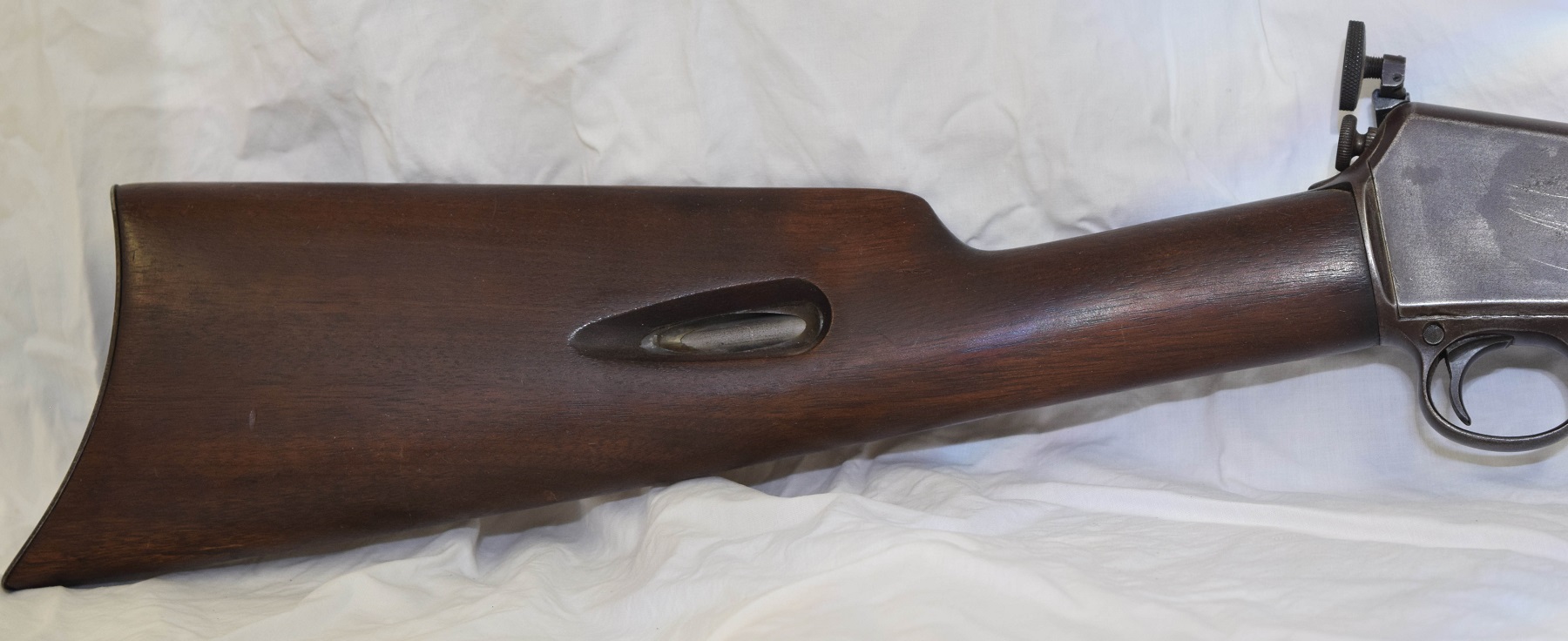
DSC_5218csThe curve of the butt stock was more along the lines of a lever action and not a semi-auto rifle.

DSC_5216cs

DSC_5215cs

DSC_5214csBy 1932  22 ammunition improved in quality enough that the rifle was re-design for this caliber and the model designation was changer to model 63. All together approximately 175,000 were made and sold.

DSC_5182cs

DSC_5185csStill using the rear tubular magazine and not magazine fed.

DSC_5187csThe front nose cap remained the same.

DSC_5190cs

However, now the butt stock was more into the design of a semi-auto rifle and checkered.

DSC_5192csThe third rifle is not a Winchester but a Taurus copy, also called the model 63.

DSC_5204csYou can see that changes were made to the feed slot for the tubular magazine. The slot is longer and at a much more gradual taper.

DSC_5196cs

DSC_5199csThe same basic nose cap was kept.

DSC_5206sThe butt stock and plate were once again changed.

DSC_5210cs

Weekend update 5-11-15

Most of this weekend was spent taking pictures for up coming write ups and going through some 1480 scans, I just got back from the scanning company, to organize them. But, some other projects were accomplished as well. The first was a new pad for the a/c unit for the cnc room. The compressor is currently located in the band saw room. However, there is to much heat build up in this room. The air compressor, air dryer, and a/c compressor exceeded the max heat load. So a new footer and stem wall was built. Here are a couple of quick pictures.

DSC_5124sThis was done the old fashion way.

DSC_5255s


DSC_5127s

DSC_5131s

Next I made a couple of hole down nuts for the cnc router mdf board.

DSC_5134s

Sunday was spent on more picture taking and working on the wire edm. The first item on that list was getting the coolant tank up on a new set of wheels.

I just have to get the tank and pumps on this rolling tool stand.

DSC_5129sYou can see the tilt due to a broken wheel bracket.

DSC_5130sThis was accomplished with a cherry picker

DSC_5260sAfter a little work it finally came to pass.

DSC_5252sNext came the task of hooking it all back up.

DSC_5251sThere were wires and plugs to connect everything. After this it was time to hook up power and see if the controller still worked. Then it hit. The transformer tripped its breaker. So after a little trouble shooting it was determined that the transformer is bad.

DSC_5253sSo if anyone knows where I can get a 230 to 200 3 phase isolation transformer rated a 7KVA please let me know.

Sunday answer 5-10-15

DSC_5111sWhat you are looking at is the spigot stem to a “Bigot”. For those of you not familiar with this weapon it is a dart firing adapter for a 1911 pistol.

The front of the shaft showing the tip of the firing pin.

DSC_5114srear view showing the back of the firing pin

DSC_5112sside view of the base. It has the dimensions of a 45 acp.

DSC_5109sback view of the base

DSC_5108scomplete assembly

DSC_5106s

DSC_5118sThe base and shaft installed in barrel

DSC_5119s

DSC_5105sRear view of the dart

DSC_5104s

DSC_5103sThis is how the dart would look pushed on to the shaft

DSC_5102sAs it would look in the pistol ready to fire

DSC_5121s

A cross section of the entire dart.

bigot_c

What is it Saturday 5-9-15

Another hard one, but it is a gun part.

DSC_5111s

Archive Photo of the Lowell Gun

Here are two pictures of a Lowell gun. It came out during the time of the Gatling, Nordenfelt and Gardener gun but at the very end of that time period. Only a few were ever made and I was lucky to photograph this one before the museum closed.

scan0006c1s

scan0006c2csSome where in the archives I have more pictures and will post them at a later date.

From the days of 35mm photography.

Cut away Tokarev TT-33

This weeks cut away in the Tokarev Model TT-33. DSC_5019cs

DSC_5020cs

DSC_5030cs

DSC_5038cs

DSC_5041s

DSC_5054cs

DSC_5055cs


DSC_5101cs

DSC_5096cs

DSC_5092cs

Magazine manufacturing

In this post we are going to look at making a magazine. In this case a 22lr pistol magazine. This magazine was stamped out on a progressive stamping die. In a machine that would look like this.

progressive-stamped-magazinesNot for the home shop.

So lets take a look at the steps that would be required to make a magazine. Starting from a role of steel metal to the final product.  The sheet steel is removed from its coil and fed into the stamping machine. The process start with the initial cut and a pilot hole or holes that serves as a locator hole for following steps in the process.

DSC_4906csThis is the stamping strip from start to finish. So lets take a closer look at the individual steps.

First step. Initial cut of the magazine and two pilot hole for locating the sheet metal for the next step.

DSC_4878csSecond step. In this step you can see that the second hole is removed as the top of the magazine is finished cut.

DSC_4879csThird step. This starts the initial bends

DSC_4880csFourth step. Now we are in the pressing of the ribs of the magazine.

DSC_4881csFifth step. Another bend step.

DSC_4882csSixth step. This is a bend step for the bottom of the magazine

DSC_4883csSeventh step. Here you can see that the slot has been punched in for the follower button.

DSC_4884csEight step. The folding over of the magazine

DSC_4885csNinth step

DSC_4886csTenth step. The magazine stamping is separated from the strip and being set up for welding

DSC_4887csEleventh step. At this point the magazine is machined welded.

DSC_4888csTwelfth step. The tab are now cut off and for all practical purposes the magazine body is complete

DSC_4889csAll that is required after this to verify fit and do your quality control inspection

Updates for the last two weekends.

Last Sunday was a much easier day. It was a large amount of fixing things as well as shop work.

The A/C went out in the house so testing was conducted and it was found that the evaporator fan went out. Time was spent on removing it to get a replacement today. Then the bad luck just continued. Both a/c’s went out in the machine shop and had to be repaired. I finished the electrical to the spot welder and got them running.

DSC_5008csAlso finished the insulating and putting on wood covers to the spot welder room doors, this should cut down the heat load through the doors a great deal.

DSC_5007csBecause of some missing parts we went through the machine shop, the metal storage room, the 20′ container and the 40′ container with a fine tooth comb. I mean to say that every cabinet, box, container, plastic bag and drawer was gone through, not once but three times by three different people. This has been an on going project which reached a head this last week with no work being done other then looking for the missing parts. We moved desks, cabinets and work benches. So by the time this was all done everything was a disaster. Saturday was spent putting to 40′ container back together again. Here are a few before pictures.

DSC_4993s
DSC_4992cs

DSC_4991csThis is a lot of cabinets to go through.

DSC_4994cs

DSC_4995sAfter we finished  going through and cleaning up and putting away everything this is what it looks like now.

DSC_5000s

DSC_4998csAll the cabinets have been labeled.

I made bottoms for the library index card cabinets so they are now being used from odd parts, like the barrel for an Astra 400 or the bolt from a Winchester 73 bolt and feed ramp, any parts that did not require a large cabinet to store them in.

We fixed a problem with the table saw and then cut a 3/4 mdf board for the cnc router.

DSC_5017cs

DSC_5018csI also finished the air system in the fab shop. Done and I am quitting for the weekend.


Just a quick update on the VG1-5 project 5-2-15

All the firing pins for the VG1-5, the Star pistol and the M1930 Sauer have been sent to  heat treat. The buffer pins are there as well. The spot welder have been wired up and the coolant system will be finished this weekend. The first rifle was sent a while ago to Greg who took it to the first testing facility for ATFE approval. The second one will be out when the parts come back from heat treat. We will be spot welding the receivers together soon and all the material for the bolts is here and going on the lathe for the first op in the near future.

My work load has dropped of a little which helps and I hope to be back making regular posts soon.

This weekend is full of mandatory maintenance projects to get the shop back in order.

That is all for now.

Making the 1930 Sauer firing pins

I went to do a little shooting on a few weapons in my collection that I have never fired only to find out that the firing pins were broken. In this case the pistol that I had taken out was a Sauer model 1930 32acp pistol. For some odd reason I happen to have three of these cute little pistols and two of them had broken firing pins. Now it was off to the computer to design up a new firing pin. Getting into this project it was determined that with three of the same pistols that there were 2 different sizes of firing pins. This is a video of the making of the firing pins.


Here is a  picture of the firing pin prior to milling it.

20150424_142840s

20150424_142835sThis is a solid works look of the part.

firing pin

The firing pin after completion in the milling machine.

20150424_143447s

20150424_143443s

20150424_143456s