Categories

Welding the rear upper housing

This post deals with welding the rear upper housing together. We start with the finished pressing of the cap.

DSC_6836cs


And mating it with the housing that we stamped earlier we end up with the final product.

IMG_0720cThis is the video of that process.

Here are a couple of close up pictures of the welded top cover.

DSC_6821s

DSC_6820sAll the top covers ready for the next step.

DSC_6819s


Pressing the rear cap for the VG1-5 rear housing

This post deals with pressing the cap for the upper housing. We start with a laser cut blank that has been de-bured.

DSC_6829cwAnd using the pressing tool.

DSC_6830wsWe end up making the cup that going into the rear upper housing to be welded in.

DSC_6822sThis is the video of that process.

Working on the VG1-5

We have just finished welding up the VG1-5 lower receiver. This is a quick video of that operation.

A few pictures to go along with the video.

A couple of close ups of the welding.

DSC_6771cs

DSC_6772sAll the lowers tig welded and ready for the next operation on the machining center.

DSC_6818s

Gun Lab update

I thought it time to do another update here at Gun Lab. Currently the major and generally only project being worked on is the VG1-5. Between the machining, pressing , welding and wood working that is required to complete this rifle we are keeping quite busy. However with that said we are still working on a few other projects as time allows. Solid modeling is continuing on the next rifle project that is coming down the line, which will be discussed in the future. We are also working on another solid model project for a friend of Gun Lab, John P. This is about all that can be handled at this time.

After the second attempt of the Japanese type 99 stamping die for the magazine this project has been put on a later time schedule. It will be picked up again after the VG1-5 is completed. Time and money dictates this.

There is tooling that needs to be completed to finish out the VG1-5 and part of my weekend is spent doing this. The cnc router control circuit and the fluting machine are two that come to mind.

A number of friends have stepped forward to help with the VG1-5 project and it is with there help that we will complete this project.

I look forward to finishing the VG1-5 project. I also look forward to starting the next projects that are coming up.

Interesting project by a friend of Gun Lab

A friend of Gun Lab just completed an interesting project and was nice enough to write up a nice article. This is being brought to you by Orin H.

Swedish M1867 Rolling Block
12.7x44R to .50-70 Government Conversion

I have a Swedish M1867 Rolling Block that was originally in 12.7x44R and you cannot find any brass for that caliber. The rifle had been “sporterized” sometime in the late 1800’s so it wasn’t original and making a conversion really wouldn’t affect its value but to me, in my humble opinion, it would actually increase its value as well as utility.
12.7x44R Brass can be made from .50-70 Government brass but you’ll find that the rim will have to be reduced in diameter, length changed, and in some cases the cartridge base in front of the rim will need to be reduced in diameter also. I found that Bertram brass rims are too thick and you’ll have to reduce the rim thickness for both 12.7x44R and .50-70.
Apparently the 12.7x44R was a modification by Sweden, Denmark, and Norway of the .50-70 Government cartridge which had been adopted by the US Government in 1866. The cartridge went by several names; 12mm Remington, 12.17x42R, and 12.7x44R to name a few. When adopted in 1867, the case was 42mm long and then in April of 1871 it was changed to 44mm so the black powder load could be increased.
Here is a comparison of the basic dimensions and drawings of each cartridge:
12.7x44R *                                                       .50-70 Government
Case Length: 43.57mm (1.715”)                           1.75”
Rim Diameter: 16.018mm (0.631”)                    0.660”
Rim Thickness: 1.63mm (0.064”)                       0.065”
Overall Length: 57.05mm (2.25”)                       2.25”

Bullet Length 24.5mm (0.965”)                          0.965”
Bullet Diameter 13.25mm (0.522”)                    0.515”
Bullet Weight 425gr                                                450gr

Bore 13mm (0.512”) **                                           0.5”
Lands 12.42mm (0.489”) **                                 0.520”

* Approximate because at the time of adoption, 1871, Sweden and Norway used a unit of measure called “Linje” or Decimal Lines. To add to the confusion, Sweden used a different value for a “Linje” and Norway another. The conversions of dimensions shown on the drawing are as close as I have been able to determine so the numbers in red are approximated metric values.
**Actual measurements of two rifle bores
As a side note, Norway started adopting the metric system in 1875, Sweden 1876, and Denmark in 1907.
I’ve never found an original drawing of the 12.7×42 or 44R cartridge in metric units and if anyone has one then I would love to get a copy.


Photo 1

Photo 2

Photo 3Above is a photo of the rifle prior to the conversion. Note that barrel has been shortened as well as the forearm. I have removed the really cheap front and rear sights that were soldered to the barrel as well as the front sling loop. I’ll be replacing them with something of a better quality but still with a “period” look. Eventually the stock and forearm will also be replaced but that’s a project for another day.

Photo 4After removing the stock and forearm, remove the cross bolt locking screws.

Photo 5After removing the screws, cock the hammer to full cock and press out the breech block pin from the right side of the receiver and withdraw the breech block. You may find that a tap, using a non-marring tool, may be necessary to remove the pin.

Photo 6You need to keep the cross pins with the hammer or breech block so that they are retained with the original component. I wrapped the breech block with tape securing the pin so it doesn’t get exchanged with the hammer pin.
After this you should ease the hammer forward, relaxing the spring tension, and remove the cross pin and hammer.

Photo 7Remove the extractor retaining screw and remove the extractor by sliding the extractor out of its recess.

Photo 8Clamp the receiver in your vise with soft or padded jaws to protect the receiver’s finish and you’re now ready to start reaming the chamber.
NOTE: You should leave the trigger guard in position to prevent any possibility of distorting the receiver when clamping it in your vise.

Photo 9NOTE: Keith does not have a web site or use emails so you’ll have to write or phone him to see if he has the reamer you need.
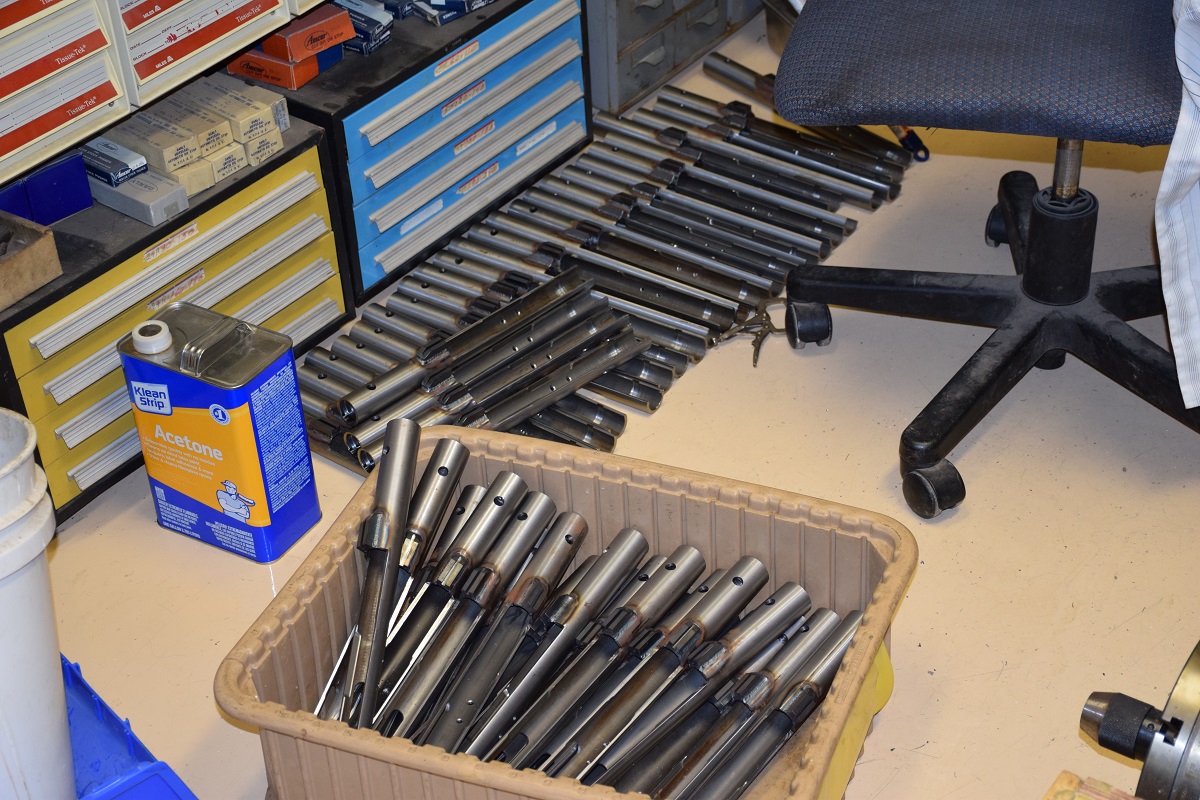
Here is the reamer I rented from Keith Rice, White Rock Tool & Die, 6400 N. Brighton Avenue, Kansas City, MO 64119 Phone (816) 454-0478 mounted in a 10” reamer T-Handle I bought off eBay. You’ll need the longer handle to give clearance for the cross bar of the T-Handle. I also use CRC HD Cutting Fluid because it has the consistency of honey and will adhere to the reamer and it’s a really slick, high pressure cutting fluid. White rock will rent you a reamer for 30 days for the same price that others charge and they only allow you to keep it 3 – 5 days. Keith is a very nice guy to deal with and his reamers are sharp so be careful.

Photo 10You will need to slug your barrel so you can let Keith know the diameter of rotating pilot he needs to supply. In my case the barrel measured .489” across the lands and the pilot Keith supplied was an exact fit. The bullet I chose is cast using a Lee 515-450 mold and my bullets are casting at 0.515” + 0.0005 to 0.001 and 418gr +0.0005 to 1.5gr using pure lead.

Photo 11Here is the reamer starting into the chamber with a good coating of cutting fluid.

Photo 12Guide the reamer into the chamber and the rotating pilot should be a snug fit into the bore. Don’t put any side to side or up and down pressure on the reamer handle. Let the reamers pilot guide the reamer so the reamer/chamber will be aligned with the bore.

Photo 13Start turning the reamer clockwise but don’t put a great deal of pressure on the handle forcing it into the chamber. Light cuts are the key and if you feel the reamer starting to stick, don’t force it. Reverse the rotation and pull the reamer out, clean it and the chamber, reapply cutting fluid and start again.

Photo 14You’ll have to repeat this process a number of times. It’s a slow process – it took me about an hour to cut mine. Notice how dark the patch is in this photo. This is the reamer cleaning out 150 years of black powder corrosion from the 12.7x44R chamber and some metal. Rechambering will also correct, unless it’s really bad, any out of round chamber which isn’t uncommon for these rifles.

Photo 15Continue the cutting process until the rim cutter part of the reamer just “kisses” the existing cartridge rim seating surface. This will give you a depth of .065” +/- 0.001” or so. Ideally you should end up with a rim depth of 0.065”. I have found that Starline brass has the most consistent and accurate dimensions and Bertram the worse.

Photo 16Insert a cartridge case and check headspace. The easiest way to do this on a rolling block is to take a straight edge and place it on the cartridge base and make sure that it is flush or slightly below the surface of the barrels Breech Face.
Once you have the rim seating depth right it’s time to modify the extractor. If you’re lucky, your extractor will be in good shape and you will be able to modify the extractor that came with the gun. In my case, the actuating “tit” on the extractor was broken off so I had to come up with a replacement. The only reasonable priced extractors (there are no originals available) I could find were .45-70 extractors sold by Numrich. I ordered two of them in case I made a mistake modifying the first one.


Photo 17AThe upper extractor is the one that came with the rifle and as you can see the breech block extractor cam slot engagement “tit” is broken off. The lower replacement is a .45-70 extractor that I obtained from Numrich.

Photo 17Here is a photo (right to left) of the original broken extractor, the modified .45-70 extractor, and an unmodified .45-70 extractor.
You’ll have to file or use a Drimel tool to get the shape of the new extractor close to the dimensions of the original. You should first get the extractor to be a snug, but free, fit into the barrel’s extractor slot then remove the excess metal from the extractor rim. I used a Drimel tool with a small grinding wheel to get it as close as I could.

Photo 18Re-insert the reamer – using a lot of cutting fluid – and SLOWLY cut the rim recess in the extractor. Use LIGHT pressure on the reamer and you’ll find that it wants to catch on the edge of the uncut portion of the extractor. Making very light cuts will finally get you the results shown in the photo.

Photo 19Here are the final results. As you can see, the fit is perfect.
The next step is to mark the barrel with the new 50-70 Government caliber marking.

Photo 20Here is the barrel after having the new chambering engraved by a local engraving shop. I chose this marking to avoid any confusion because there were several different .50 caliber cartridges produced during the time period when the rifle was made.
After test firing, the next step will be to mount new sights, sling swivels, and refinish the metal and stock.


Thank you very much Orin.

If anyone else has a project they would like to share please drop me a line. I would be happy to post it.


Update on the VG1-5, upper receiver

We have been working on the VG1-5 at a steady pace to try and finish this project. This last week has been spent on the upper receiver. The lathe work has been completed on the upper and now we have started on the operations that have to take place in the machining center. This video shows the actual machining that we did a master cam simulation on earlier.


This first picture is of the set up we used to machine the upper receiverDSC_6625sThe stop to position the part correctly and the rear clamping device.

DSC_6626sThe front clamping device

DSC_6627sThis next set of pictures is of the final op’s completed on the receiver.

The cut out for the guide block. It still needs to be de-bured.

DSC_6793sThe large hole for riveting the front sight on.

DSC_6795sThe small hole for the front sight

DSC_6796sThe completed machining op on the upper.

DSC_6798scWorking our way through the upper receivers.

DSC_6768s

All the machining on the upper receivers will be completed this week. Moving ahead.

Interesting AR-18 tool

It is not often that most people think how something was done in the “Old Days” but I do. Lots of times you can not reproduce a part using modern machinery with a great deal of work. The “Old Days” I am talking about is not the 1600,1700, 1800, but the middle 1900’s. I just received some real interesting pictures on making the AR-18 bolt carrier. Did you ever thing how they made the bolt cam track on an early AR-18. This is the days before cnc machining. This is the tool used to make the cam in the bolt carrier for the first prototype rifles.

scan_Page_1cs


scan_Page_2sscan_Page_4s

scan_Page_3s

scan_Page_5s

Sorry for the quality of the pictures, it is how they cam. If anyone knows the were about of this tool please contact me. I would like to take better pictures.

Sunday Answer 10-4-15

Okay had enough on this what is it Saturday. It was a tough one. A friend of Gun Lab sent this to me to add to my reference library.

It is an early rear sight aperture spring for the very first AR-18’s. It never went into production. I am looking for pictures of these rifles or drawings of this rear sight. If and when I find it I will post it here.

DSC_6801csAs sent to taped to the card.


What is it Saturday (Late)

Sorry about not keeping up with the What is it Saturday part of this blog. Life has been a little hectic but I am working at bring it back.

This is going to be a hard one so guess away.

DSC_6788c

DSC_6789c

DSC_6785c

DSC_6787c

DSC_6786c

Another old video on making the 1903 springfield


This is another video in the series of early gun making. This on shows the forging of the 1903 bayonet and making the barrel for the 1903.

https://www.youtube.com/watch?v=qq0-CDfiH8Q